Check Availability

7 Ways To Spot A Fake Montessori Toy 

By Amy McClellan

Founder of Nooche, mum of 5, and the woman behind the original handmade Montessori busy board that's being copied by every factory on Temu and Amazon right now.

See the original Nooche Busy Board →

Before I get into this, I want to tell you who I am and why I'm writing this.


My name is Amy McClellan. I'm a mum of 5. A few years ago I made the first Nooche Busy Board for my own kids because I couldn't find a Montessori toy that actually did what the marketing promised. It took months of designing, testing, sewing, and refining before I had something I was willing to put in front of a toddler. When other parents started asking me to make them one, Nooche was born.
I never set out to run a business. I just wanted to make something safe and real and genuinely useful for my own children and the parents around me.


Then something I didn't expect happened.


Overseas factories started copying us. They screenshot my photos. They lifted my product videos (the ones I filmed in my own home studio, with my own kids). They started selling cheap knock-offs on Amazon, Temu, Etsy, and TikTok Shop using my content to sell their fakes.


The reason it hurts isn't just the lost sales. It's that parents are buying what they think is my board, receiving a cheap replica, and then emailing me asking why the one I sent them is falling apart. I have to tell them they didn't order from me. They ordered from a copycat using my photos.


This has happened enough times that I'm writing this guide. Because real parents are being tricked, and real kids are ending up with cheap, uncertified toys that aren't safe for them.


Here are 7 ways you can tell a real Montessori toy from a fake, before you order anything.

the problem with "montessori" right now

"Montessori" has become one of the most abused words in children's products. Walk down any toy aisle, scroll any Amazon listing, open any Temu product page, and you'll see "Montessori" slapped on toys that have nothing to do with Montessori principles.


Here's the uncomfortable truth. Almost every "Montessori" toy you see sold cheap online is not Montessori. It's a mass-produced plastic toy with the word printed on the packaging because the word sells. That's it. There's no methodology behind it. No developmental testing. No design informed by actual Montessori practice.


Real Montessori toys are designed around specific developmental principles. They use real materials. They develop real-world skills. They're made in small quantities by people who understand what they're building. And they almost never cost under $30, because that's genuinely not possible if you're using the right materials and the right process.


Here's how to tell what you're actually buying.

1. check the price. real handmade montessori toys can't be under $25.

This is the single easiest giveaway, and I'll be the first to tell you.


If a "Montessori busy board" is being sold on Amazon or Temu for $15, $19, or $25, it is not handmade. It is not made with certified safe materials. It is not designed by anyone who understands Montessori principles. It is a factory-line product with the word "Montessori" printed on the packaging.


I'd love to be able to sell my boards cheaper. I can't. The materials alone cost more than those listings are charging you at retail. The real buckles (not the plastic ones that break in a week) cost more. The CE-certified fabrics cost more. The time it takes to sew each board by hand costs more.


I charge what I charge because I refuse to cut the corners the factories cut. If my board was $19, it wouldn't be my board anymore. It would be theirs.


Rule of thumb: anything under $25 is almost certainly a fake. Anything in the $25 to $40 range is a copy made with sub-standard materials. Real handmade Montessori boards start around $50 and go up from there.

2. Count The Pages. Fakes Almost Always Have 3. Ours Have 8.

Every real Nooche Busy Board has 8 full pages of activities. Each page targets a different combination of fine motor skills, cognitive development, and language opportunities.


The cheap knock-offs almost always have 3 pages. Sometimes 4 at the very top end.


The reason is simple. Pages cost materials, labor, and quality-check time. Factories cut them out because they cut into margin. 3 pages mean a child masters the board in a week and loses interest. 8 pages mean the board grows with your child from 1 to 3.


How to check: look at the product photos in any busy board listing. Count the pages shown. If it's 3 or 4, close the tab. If it's 8, you might be looking at the real thing (or you might be looking at someone who stole our photos. Which brings me to the next point).

3. Check If The Photos Are Stolen From Us
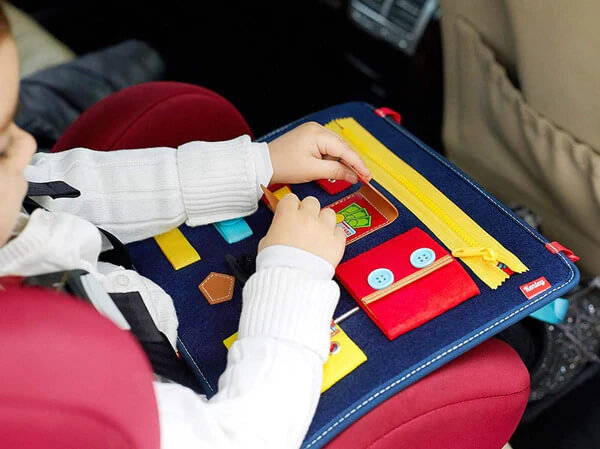
This is the one that genuinely hurts.


Dozens of overseas sellers have been using my own product photos and videos to sell their fakes. They screenshot my Instagram. They clip my TikTok videos. They lift my website images. Then they list a completely different product under my photography.


How to check: reverse-image search any busy board listing you're thinking of ordering. Right-click the main image, "search image with Google," and see what else comes up. If my photos appear on noocheplus.com and also on three different Amazon sellers listing the same photo, the Amazon sellers are not me. They're using my content to sell their product.


Another check: look at the seller's other listings. Nooche only sells Nooche. If the seller also lists plastic kitchenware, phone cases, and garden tools, you are not buying from a Montessori brand. You are buying from a reseller who copied a Montessori brand.

4. Look For Real Safety Certification (Not A Logo On The Box)

Every Nooche board is made with CE-certified materials. The fabrics, plastics, dyes, adhesives, and small parts have all been tested by an independent lab for the substances that matter (lead, BPA, phthalates, formaldehyde) and for mechanical hazards.


Most of the cheap listings on Amazon and Temu are not certified to any independent standard. Some put a "CE" logo on the packaging with no actual test report behind it, which is a growing problem in the children's product category.


How to check: ask the seller for their CE test report and lot number. Real certified products have real test reports from independent labs. Fakes will either ghost you or send you a screenshot from someone else's certificate.


This matters more than price. Your child is going to put the board in their mouth. The materials have to be safe.

5. Check The Buckles And Hardware

This is a trick I learned from a parent who returned a cheap knock-off and sent me photos to compare.


Real handmade Montessori boards use real functional hardware. The buckles are the same buckles you'd find on a real backpack or seatbelt. The zippers are real YKK-grade zips. The latches are real metal latches. The buttons are real sew-on buttons.


Fake boards use cheap plastic imitations of all of these. The buckle looks like a buckle in the photos but when you try to use it, it won't click properly, or it clicks once and then breaks. The zipper is a thin printed strip of plastic. The latches are glued on and come off in a week.


The whole point of a Montessori busy board is that the child is rehearsing real-world skills. If the buckles aren't real buckles, your child is practicing on something that doesn't match what they'll encounter in real life. The skill doesn't transfer.

6. Read The One-Star And Two-Star Reviews

This is the trick that saves parents the most money.


The five-star reviews on cheap listings are often paid, incentivised, or generated by review farms. The pattern is obvious once you look for it. Vague praise, no specifics, similar sentence structure, uploaded in clusters.


Filter the reviews on any listing to one and two stars only, and read those.


The pattern on cheap knock-off busy boards is always the same:
"Pages fell out in the first week."
"Buckle came off on day two."
"Strong chemical smell when it arrived."
"Nothing like the photos."
"Stitching came apart in the wash."
"Very cheap feeling, wouldn't give it to my child."


Those reviews are the honest ones. If the low-star reviews say the product falls apart, believe them. It falls apart.

7. Look At The Brand Behind It

Real Montessori brands are built by someone. There's a founder story. There's a face. There's a reason the brand exists beyond "we spotted a trending product on TikTok and copied it."


Nooche was built by me, a mum of 5, in my own home, because I needed something better for my own kids. Every board we sell still runs through our small team of real people making real products by hand. I personally see the quality on every batch before they ship.


How to check: does the brand have an About page with a real founder? Real photos of real people? A story that makes sense? Real reviews from real customers that mention specific details and products over time?


Or is it a nameless Amazon seller with a generic brand name made of random letters (BTYUKNQ Toys, KGFJHQA Products) and a listing that was created three months ago?


If you can't tell who's behind the brand, you're not buying from a brand. You're buying from a reseller.

Title

Why I'm Writing This Instead Of Just Running Ads

I'll be honest with you.


I'm a small business. I have 5 kids. My team is tiny. We can barely make 1000 boards a year because every single one is handmade and we won't cut corners on materials. We can't compete with the overseas factories on volume or price. We never will.


What we can do is make the best board on the market and tell parents the truth about what's happening in this category.


Here's what's actually going on. My boards sell out every year before Christmas because we physically can't make more than our capacity allows. The factories that copy us watched our product sell out, saw the demand, and started mass-producing cheap versions using our photos. Parents who meant to order from me ended up ordering from them. And when their cheap board arrived falling apart, they emailed me asking what went wrong.


Those emails are what made me start writing. I don't want parents being tricked. I don't want kids ending up with uncertified toys. And I don't want the Montessori name turned into a factory-line marketing word that means nothing.


If you're going to buy one Montessori busy board for your child, please get the real one. Not for me. For your kid.

What Parents Are Saying About The Real One

Here are a few reviews from parents who ordered the actual Nooche board.

"After buying two fakes from Amazon, I finally found the real one."

I bought two different "Montessori" busy boards from Amazon before I found Nooche. Both were falling apart within a month. One of them smelled like chemicals so strongly I had to throw it out. The Nooche is in a completely different league. The buckles are real. The pages are proper. My daughter has been using it every day for 6 months and it still looks new.

Rachel K. Verified Customer

"You can tell this is handmade. The quality is obvious."

I was skeptical about paying more for a busy board when there are so many cheaper options. Then I unboxed the Nooche. You can genuinely tell this is handmade. Every stitch is deliberate. Every buckle works properly. Every page is designed. My son is 2 and he's obsessed with it.

Emma T. Verified Customer

"Took a while to arrive, worth every minute of the wait."

Yes it took longer to arrive than Amazon would have. That's because they're handmade and there's only so many Amy and her team can make. I don't care. The board is incredible. My twins fight over whose turn it is. It's the best money I've spent on a toy, ever.

Priya N. Verified Customer

"I almost bought a $19 one. So glad I didn't."

I was literally about to click buy on a $19 "Montessori busy board" on Temu when I saw an article from Amy explaining how to spot a fake. Decided to spend the extra on the real one. Three months later I'm so grateful. The cheap one would have been in the bin by now. My Nooche board is still her favourite toy.

Sarah W. Verified Customer

Please Order Soon If You Want One Before Christmas

We sell out every year before Christmas. Every single year.


Last year it was mid November. The year before was late October.


This year we're hiring extra help to try and keep up with demand, but there's a limit to how fast we can scale a handmade product without compromising quality (and I won't compromise quality, which is the whole reason the brand exists).


If you want a real Nooche Busy Board under the tree, please order sooner rather than later. If it's showing available when you click through, grab it. When we're out, we're out until the next batch, which usually ships in late January.

Title

The Honest Bottom Line

Your child is going to spend the next few years playing with whatever you put in front of them. What they play with genuinely matters for their fine motor skills, their attention span, their language development, and their safety.


You can spend $19 on a factory-made knock-off that uses my photos, falls apart in a month, isn't certified safe, and teaches your child nothing about real-world skills because the buckles aren't real buckles.


Or you can spend more on the real one. The handmade, CE-certified, 8-page, actually-Montessori board that was designed by a mum who built it for her own kids first.


I'm not asking you to buy from me because I'm a small business, although I am. I'm asking because your kid deserves the real thing.

See the original Nooche Busy Board →

Handmade in small batches. CE certified. Everything else is a copy.

With love,
Amy
Founder of Nooche
Mum of 5

Title

Nooche Busy Board

4.9

|

3,650+ verified buyers

Handmade to highest safety standards

8 Full pages of Montessori activities

CE Certified & 100% Toddler Safe

Replaces screen time naturally

Check Availability →

Handmade to order. Ships worldwide. CE certified. Featured in the news.